
Pilot Demonstration Explained: How Pilot Programs Run Demo Flights, Flight Trials, and Proof of Concept Flights
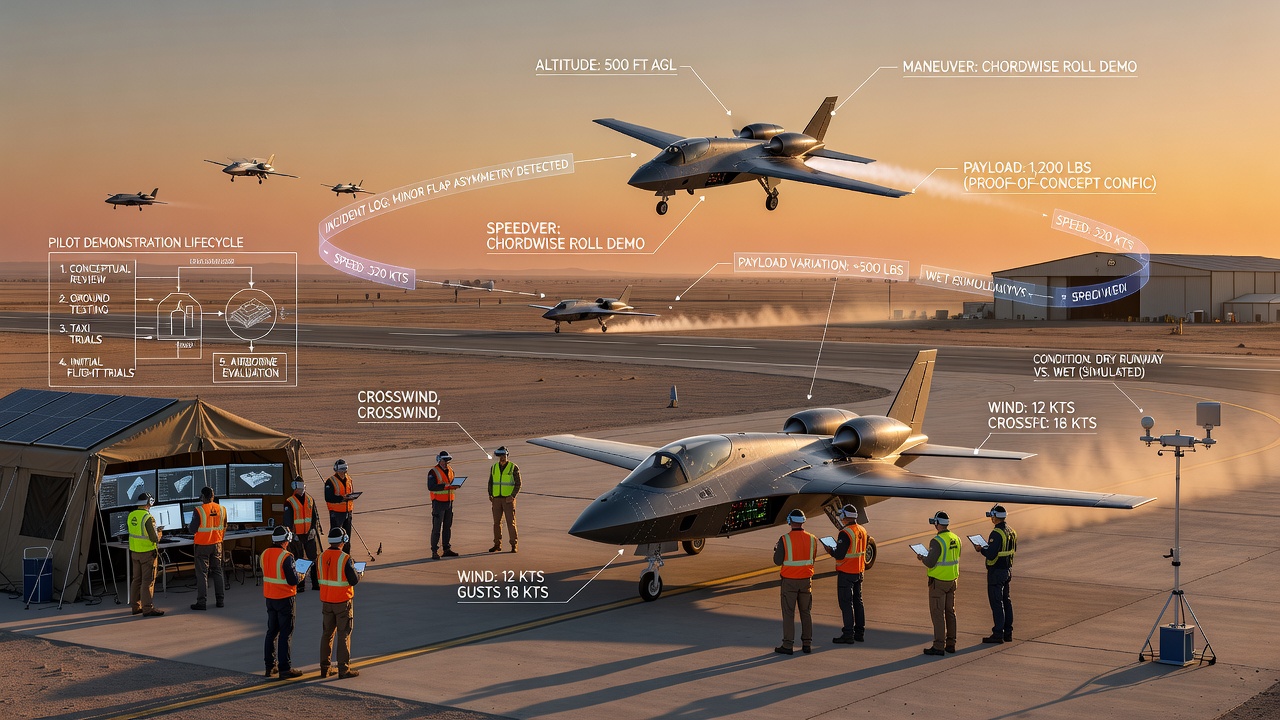
A single test flight can cost an aerospace company more in insurance and airspace clearance than the aircraft itself. That reality shapes almost every decision made before an engine ever spins up on a runway. Before any aircraft, drone system, or aviation technology reaches commercial service, it passes through a carefully structured pilot demonstration - a controlled process designed to answer one question with certainty: does this actually work outside the lab?
The mechanics behind these evaluations are rarely discussed outside engineering circles, yet they determine which technologies eventually carry passengers or cargo and which quietly disappear. A well-run pilot program blends regulatory strategy, operational planning, and risk management into a single sequence of events. Some organizations even use simplified simulation formats - you can see a lighter, gamified version of this concept in a pilot demo - to illustrate how staged testing works before committing to full-scale trials. Understanding how a demo flight differs from a flight trial, and how both feed into a proof of concept flight, gives a clearer picture of how aviation innovation actually gets validated.
This piece breaks down the entire process - from planning through data analysis - so the logic behind pilot demonstrations becomes transparent rather than mysterious.
What a Pilot Demonstration Actually Involves
A pilot demonstration is not a single event; it's a structured evaluation designed to test whether a system, aircraft, or operational concept performs as intended under real or near-real conditions. It sits at the intersection of engineering validation and business justification. Companies run these demonstrations to convince regulators, investors, or internal stakeholders that a concept deserves further investment.
Defining the Core Objective
Every pilot demonstration starts with a narrow, testable question. It might be whether a new propulsion system maintains stable output during rapid altitude changes, or whether an autonomous navigation package can hold course without human intervention. The narrower the objective, the more useful the resulting data.
Who Initiates and Oversees the Process
Manufacturers, research institutions, and regulatory bodies typically share responsibility. Engineering teams design the test parameters, while safety officers and compliance staff verify that the demonstration meets airspace and operational standards. In many cases, a government aviation authority observes or co-signs the results.
Distinguishing Demonstration from Full Deployment
A demonstration proves feasibility; it does not certify a system for commercial use. That distinction matters because stakeholders sometimes confuse a successful demo with market readiness, when in fact it's only the first checkpoint in a much longer certification path.
- Defined success criteria established before testing begins
- Limited scope - one variable or system tested at a time
- Documented results shared with regulators or investors
The Role of a Pilot Program in Aviation Innovation
A pilot program is the broader framework that houses individual demonstrations, trials, and test flights. Where a demonstration answers a specific technical question, a pilot program manages the entire lifecycle of testing - scheduling, resource allocation, risk assessment, and iterative improvement.
Structuring a Multi-Phase Pilot Program
Most programs unfold in stages: conceptual review, simulation, controlled ground testing, and finally airborne evaluation. Each phase must clear specific benchmarks before the next begins. Skipping stages introduces risk that regulators are unlikely to tolerate.
Budgeting and Resource Planning
Pilot programs are expensive relative to their scale, largely because of insurance, specialized personnel, and airspace coordination costs. Organizations often underestimate the administrative overhead required to secure temporary flight authorizations, particularly when testing near populated areas.
Managing Stakeholder Expectations
Investors and partners frequently expect faster results than aviation testing allows. Program managers must communicate that a pilot program is iterative by design - early failures are data points, not setbacks.
Demo Flight: Purpose, Planning, and Execution
A demo flight is typically the most visible portion of a pilot program - the point where an aircraft or system performs in front of an audience, whether that audience is a regulator, a client, or the media.
Setting Realistic Flight Parameters
Demo flights are choreographed carefully. Altitude, speed, duration, and maneuvers are selected to showcase strengths while avoiding conditions that haven't been sufficiently tested internally.
Pre-Flight Verification Checklists
Before any demo flight, engineering teams run through mechanical inspections, software diagnostics, and weather assessments. A demo flight that fails publicly can damage credibility far more than a private test failure, so preparation tends to be exhaustive.
Presenting Results to Stakeholders
After the flight, teams compile performance logs, sensor readings, and pilot or operator feedback into a report. This becomes the evidence base used to justify continued funding or regulatory progression.
Flight Trial: Testing Under Controlled Conditions
A flight trial differs from a demo flight in one key respect: it prioritizes data collection over presentation. There's no audience to impress - only variables to measure.
Designing Trial Protocols
Engineers define specific test conditions - crosswind thresholds, payload weights, temperature ranges - and repeat trials across those variables to build a statistically meaningful dataset. Repetition matters more here than in a demo flight, since single-instance results can mislead.
Handling Anomalies and Failures
Flight trials are where most technical problems surface. A well-designed trial anticipates this, building in contingency procedures so that an anomaly becomes useful information rather than a safety incident.
Comparing Flight Trials Across Iterations
Teams often run multiple flight trials across weeks or months, adjusting one variable at a time. This iterative comparison reveals whether performance improvements come from genuine engineering fixes or simply favorable conditions.
- Controlled variable isolation for cleaner data
- Repeated runs to establish statistical reliability
- Detailed incident logging for regulatory review
Proof of Concept Flight: Validating the Bigger Idea
A proof of concept flight asks a different question than a demo flight or flight trial. Instead of testing a component or a maneuver, it validates the entire operational premise - can this aircraft or system function as a viable solution in its intended environment?
Defining Success at the Concept Level
Success here is measured against the original business or engineering hypothesis. If the concept was an electric aircraft capable of short regional hops, the proof of concept flight must demonstrate that capability under realistic route conditions, not just in a sanitized test corridor.
Bridging the Gap Between Testing and Certification
Regulatory bodies often treat a successful proof of concept flight as the trigger point for formal certification discussions. It signals that the underlying idea has moved beyond theory into demonstrated capability.
Common Pitfalls That Undermine Proof of Concept Results
Overstating results, testing under artificially favorable conditions, or ignoring edge-case failures are frequent mistakes. A proof of concept flight loses credibility fast if its conditions don't reasonably reflect real-world deployment.
How These Elements Connect Into a Cohesive Testing Strategy
None of these components function in isolation. A pilot program provides the structural framework; the demo flight builds external confidence; the flight trial generates rigorous data; and the proof of concept flight ties everything back to the original hypothesis.
Sequencing Decisions for Maximum Efficiency
Organizations that sequence these steps poorly - for instance, running a public demo flight before completing sufficient flight trials - risk embarrassing failures or, worse, safety incidents. Sequencing should always follow the logic: internal trials first, external demonstrations second.
Feeding Results Back Into Design
Data from each phase should inform design revisions before moving forward. Treating each stage as a closed loop rather than a linear checklist produces stronger final outcomes.
Communicating Progress to Regulators and Partners
Transparent reporting throughout the process builds trust with aviation authorities, which often shortens certification timelines later. Withholding unfavorable data, by contrast, tends to surface eventually and damages long-term credibility.
Frequently Asked Questions
What's the practical difference between a demo flight and a flight trial?
A demo flight is designed to showcase performance to an external audience under favorable, well-rehearsed conditions. A flight trial focuses purely on data collection, often repeating tests under varied and sometimes challenging conditions to build a reliable performance record.
How long does a typical pilot program take from start to finish?
Timelines vary widely depending on aircraft complexity and regulatory requirements, but most aviation pilot programs span several months to a few years. Programs involving new propulsion technology or autonomous systems typically take longer due to additional safety review layers.
Can a proof of concept flight fail and still be considered valuable?
Yes. A failed proof of concept flight that produces clear diagnostic data is often more valuable than a partially successful one with ambiguous results. Failure identifies specific weaknesses that engineers can address before committing further resources.
Who decides whether a pilot demonstration meets its success criteria?
Success criteria are usually defined jointly by engineering teams and regulatory observers before testing begins. Post-flight, a review committee - often including independent safety assessors - evaluates the results against those pre-set benchmarks.
Do smaller companies face different challenges running pilot programs than large manufacturers?
Smaller companies typically face tighter budgets and less regulatory experience, making early-stage flight trials riskier from a financial standpoint. Larger manufacturers usually have dedicated compliance teams and established relationships with aviation authorities, which can streamline approval timelines significantly.
What happens after a successful proof of concept flight?
A successful proof of concept flight usually leads to expanded testing phases, formal certification applications, and increased investment or partnership interest. It marks the transition from experimental validation toward a defined path to commercial or operational deployment.